
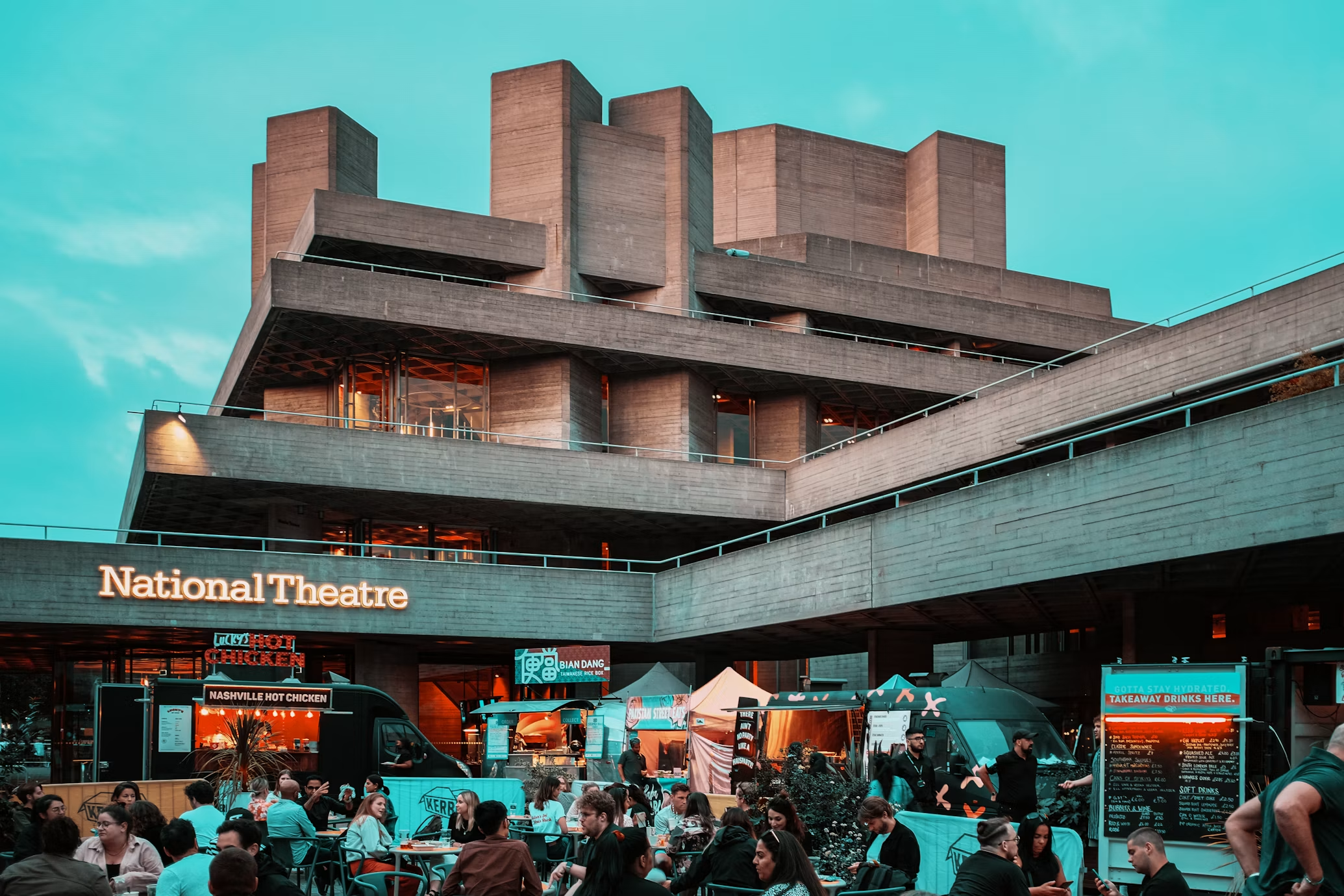
The National Theatre — London’s Modern Stagecraft
The National Theatre is one of the most influential cultural institutions in the United Kingdom. It stands on the South Bank not as a monument, but as a working engine of contemporary theatre: a place where new writing is tested, classics are re‑examined, and the boundaries of performance are pushed with quiet confidence.
It is the artistic counterweight to the West End’s commercial power. If the West End is spectacle, the National Theatre is inquiry.
A Building Designed for Ideas
The National Theatre occupies a Brutalist complex overlooking the Thames. Its architecture is often debated, but its purpose is clear: three theatres under one roof, each with a distinct identity.
- Olivier Theatre — the largest, with an open stage inspired by ancient amphitheatres
- Lyttelton Theatre — a proscenium space suited to classic and contemporary drama
- Dorfman Theatre — an intimate, flexible room for experimental and new work
Together, they form a laboratory for British theatre.
A Repertory Model That Shapes the City
Unlike the West End, the National Theatre operates on a repertory system. Several productions run simultaneously, rotating weekly. This creates a rhythm that feels closer to a cultural institution than a commercial venue.
It allows:
- long development cycles
- risk‑taking
- new playwrights to emerge
- unconventional staging
- political and social themes to be explored without commercial pressure
The National Theatre is where British theatre renews itself.
New Writing and Contemporary Voices
The institution is known for championing new writers. Many of the UK’s most significant contemporary playwrights had their early work staged here, often in the Dorfman before transferring to larger spaces or the West End.
The National Theatre’s commitment to new writing is not a slogan. It is structural: funding, dramaturgy, workshops, outreach, and long‑term artistic development
Classics Reimagined
The National Theatre also revisits classic texts — Shakespeare, Chekhov, Sophocles, Shaw — but never as museum pieces. Productions often use modern staging, diverse casting, and contemporary political framing.
The aim is not to preserve the canon, but to interrogate it.
Accessibility and Public Mission
The National Theatre is subsidised, which shapes its identity. It offers:
- multiple ticket price tiers
- reduced‑price schemes
- educational programmes
- community outreach
- digital broadcasts through NT Live
This is theatre as a public good, not a luxury.
The National Theatre Today
Today, the National Theatre remains one of the most important cultural spaces in London. It balances heritage and innovation, tradition and experimentation, public mission and artistic ambition.
It is a place where London thinks aloud.


